From Cardboard to Climate-Smart Innovation: Oscar’s Journey Through the Efficiency for Access Design Challenge and beyond
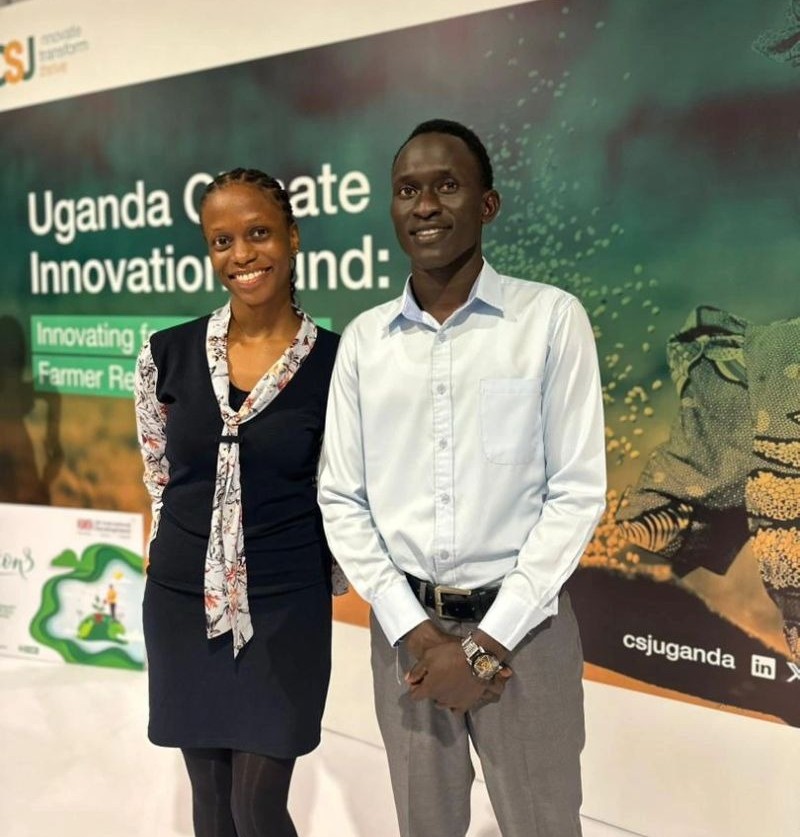
Makerere University student and Ecoflash Ltd founder, Oscar Brian Ojok, set out to solve a problem he couldn’t ignore: the enormous post-harvest losses faced by cassava farmers in Northern Uganda. Alongside team members Joyce Ruth Agilo and Lynnete Bananuka, Oscar’s journey through the Efficiency for Access Design Challenge and Accelerator Programme shaped not only his innovation, but the future of his start-up.
The Efficiency for Access Accelerator Programme is a three‑month initiative that supports alumni of the Challenge by providing tailored mentoring, business model development, and market strategy training to help transform student prototypes into early‑stage ventures. Oscar’s innovation, the Ecoflash Dryer, is a solar‑ and biomass‑powered cassava drying system designed to reduce post‑harvest losses by offering a faster, reliable alternative to traditional sun drying methods.
Oscar spoke to us about how Efficiency for Access supported him from idea to real-world impact, including support in the all-important prototyping stage.
How It All Began
I never planned to start a company. In fact, I thought I’d spend my career designing roads and bridges. Growing up in Kole District in Northern Uganda, every season I watched women in my community spread freshly harvested cassava on the bare ground to dry. My own mother had once lost her entire harvest to mould.
Uganda produces around 3.5 million tonnes of cassava each year, yet up to a quarter of it never reaches the market. That’s nearly a million tonnes of food lost simply because farmers have no reliable way to dry cassava except under the sun.
I didn’t set out to start a company. I just wanted to solve a problem in my community. I gathered a few friends and we started experimenting. We built our first prototype, which was a rough cardboard box that barely worked, but it captured our idea: a way to dry cassava that didn’t rely on unpredictable sunshine. We had no money, no experience, and no clear next step. That’s when we discovered the Efficiency for Access Design Challenge. We needed someone to tell us if this idea was even worth pursuing.
“For an idea that started on cardboard, it felt unreal”
Through the Challenge, we were paired with our mentor who pushed us to rethink our design, rebuild what wasn’t working, and make the concept truly feasible. The programme also provided £1,340 in prototype funding, which allowed us to build two new versions of our dryer. For me, Version 3 was a turning point: fully automated, solar-powered, and even able to run on cassava waste when sunlight was low.
In June 2025, we won silver at the 2024-25 Grand Final. For an idea that started on cardboard, it felt unreal.
From Engineers to Entrepreneurs
Having a strong prototype didn’t mean we knew how to build a company. Four engineering students with an innovation is not the same as four founders with a business plan. That’s why we applied for the Efficiency for Access Design Challenge Accelerator Programme.
The Accelerator provided structure, strategy, and a pathway forward. We were paired with a second mentor who helped us define our business model and understand what it means to be investor-ready. Beyond mentorship, every programme-based training session came with templates, slides, and recordings. I saved them all in a folder that I still return to every time we need to make an important decision.
With a stronger prototype and a credible business model, new opportunities began opening up. We started winning competitions and grants:
- 110 UGD at Makerere University’s Think Outside the Box Challenge
- 1,500 UGD at the NTV Skillfest Startup Africa Olympiad
- People’s Choice Award at the Makerere Innovation and Incubation Centre’s Graduate Innovation Programme
- Runner-up prize of 500 USD at PitchFest 2025
None of these achievements existed before Efficiency for Access. This programme didn’t just support our invention; it changed what was possible for us in this field.
Looking Ahead
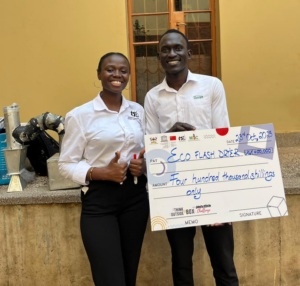
Before the Efficiency for Access Design Challenge, I was just a student with a barely functioning prototype and no network, or an iota of business experience. Off the back of the Design Challenge Accelerator Programme, we officially registered Ecoflash Ltd. We now have a validated, climate-smart innovation that generates revenue, built by a team that knows what it’s doing. What started as an attempt to solve a problem in my community is now a company with the potential to transform how cassava is dried in rural regions across Uganda.
Ecoflash is still growing, but we’re on the path we once only dreamed about. And as we work to scale our technology, I carry with me the lessons, mentorship, and opportunities that made all of this possible.