Reflections from COP30
Insights and key takeaways from COP30 in Belém, Brazil: Advancing climate resilience through clean energy access, access to sustainable cooling, agriculture, and community-led innovation
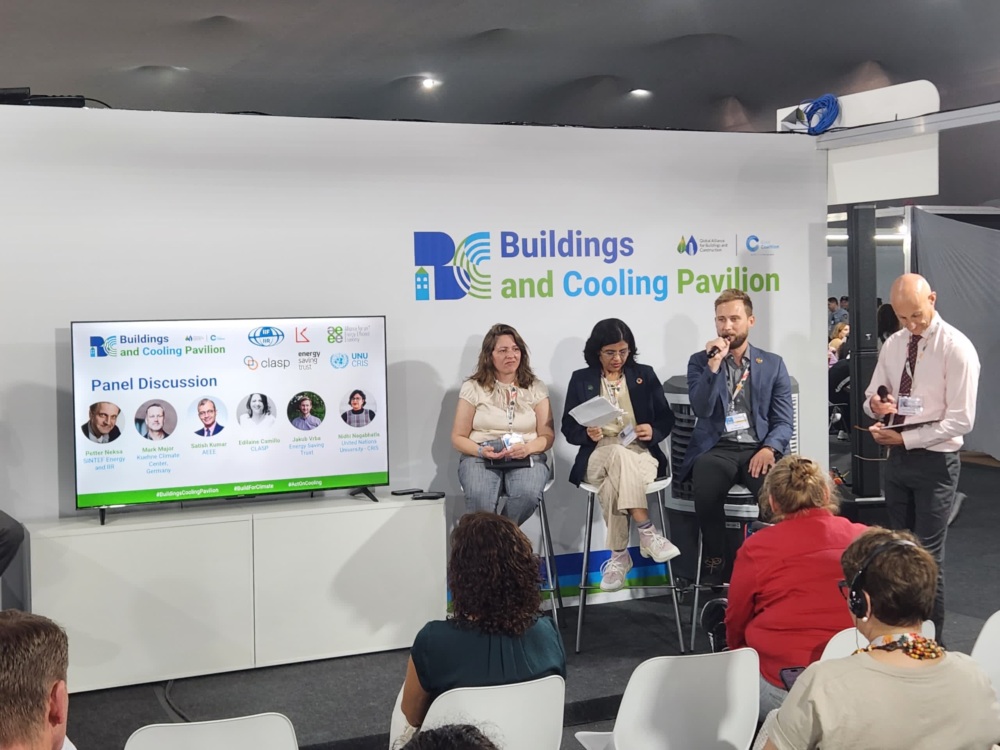
Efficiency for Access joined policy makers, innovators, and advocates at COP30 in Belém, Brazil. Dubbed the ‘implementation COP’, the conference aimed to translate climate pledges into tangible action. We were encouraged to see clean energy access gaining prominence in the discussions.
In no particular order, here are our five key takeaways from the conference.
-
Energy access and efficiency must be pursued as one system
The Brazilian Presidency shone a spotlight on universal energy access, but COP30 also made something else clear: efficiency is no longer optional. It is the multiplier that makes access scalable, affordable, and resilient.
At two high-level roundtables co-hosted by Sustainable Energy for All (SEforALL), the Climate High-Level Champions, the International Energy Agency (IEA), and the International Renewable Energy Agency (IRENA), Emilie Carmichael and Jakub Vrba of Energy Saving Trust, co-Secretariat of Efficiency for Access, highlighted that affordability remains the highest barrier for rural, low-income households. Smart subsidy design, such as the pioneering work of the Rural Energy Access Lab (REAL), will be essential to reach the most remote rural communities.
-
Cooling is central to climate resilience; our challenge is to make it inclusive
The conversation around cooling shifted meaningfully this year: from a technical afterthought to a central adaptation challenge. Launched on 11 November, UNEP’s Global Cooling Watch 2025 introduced the first framework to track access to cooling.
Energy Saving Trust, as co-secretariat of Efficiency for Access, worked closely with the Cool Coalition and SEforAll to ensure rural and off-grid communities are reflected in the report’s adaptation narrative. Moving forward, we need to ensure that off-grid communities’ voices are represented in conversations on space cooling. This urgency was echoed by a major announcement during Week One, when philanthropies including Wellcome, The Rockefeller Foundation, the Gates Foundation, Bloomberg Philanthropies, and Efficiency for Access funder, the IKEA Foundation, launched the Climate & Health Funders Coalition — a $300M commitment focused on extreme heat, air pollution, climate-sensitive infectious diseases, and integrating climate & health data to build more resilient health systems.
-
The agriculture-energy nexus gains traction
COP30 showcased increasing commitment to fostering true integration between food systems and renewable energy.
Discussions hosted by SNV’s Power for Food Partnership and the Action for Food Hub emphasised that while sectors have different priorities, they share a common goal: resilient food systems. Marilia Bezarra, Chief Innovation Officer, at the IKEA Foundation, one of the Low Energy Inclusive Appliances Programme’s funders, emphasised the vital role funders play in helping partners work together — because when efforts are aligned, we can create solutions that link food systems and access to renewable energy. Unveiled at the Africa Food Systems Forum in September, the Agri-Energy Coalition will play an essential role in driving forward collaboration in this area.
-
Innovation is thriving at the edges of the energy system; now finance and policies must catch up
From Kara Solar’s solar-powered e-boats in the Amazon to an end-to-end cold chain solution created by Adili Solar Hubs in Northern Kenya, COP30 highlighted that transformative innovation often emerges where systems are most fragile.
These examples remind us that technology alone is not the bottleneck. A successful rollout of innovative solutions needs to be underpinned by a positive enabling environment including finance and policy.
-
Adaptation finance needs to be prioritised alongside investment in mitigation
While mitigation remains critical, adaptation must also receive far greater investment. Despite new pledges of $58.5 million to the Adaptation Fund, there is still a significant gap, with the United Nations Development Programme estimating an annual shortfall of $310 billion. However, COP30 was also called the ‘COP of adaptation’, reflecting the prominence of adaptation in negotiations. Progress was made with the agreement on a reduced set of indicators under the Global Goal on Adaptation (GGA), providing countries with a framework to track resilience efforts. In addition, the presidency’s ‘global mutirão’ decision calls on nations to triple adaptation finance by 2035, signalling a stronger commitment to supporting vulnerable communities.
COP30 makes one thing clear: integrated approaches are crucial to driving down emissions and ensuring that the most vulnerable communities can thrive amidst rising temperatures. Climate resilience, clean energy access, sustainable cooling, climate-smart agriculture, and innovation are interconnected challenges, and must be treated as such through increased collaboration to break down the silos that still exist today.
As co-secretariat of Efficiency for Access, Energy Saving Trust will continue to champion integrated solutions that prioritise the most vulnerable, elevate locally owned innovation, and ensure that implementation delivers on its promise.